


How Coating Thickness Affects NBR/FKM Coated Steel Coil Performance
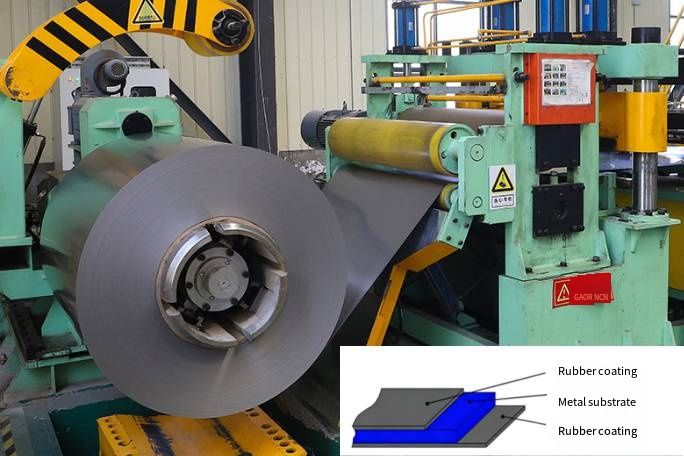
Figure: Rubber-coated steel coil production line and structure diagram – total thickness determined by substrate and coating layers. Custom thickness and structure available.
Coating thickness directly determines sealing performance, damping capacity, and stamping feasibility. Thin coatings suit precision sealing; thick coatings suit brake shims and high-damping applications. Many field failures—including insufficient sealing, stamping delamination, and premature fatigue—are not caused by material quality alone, but by a mismatch between coating thickness and actual working conditions.
This article is provided by Jinan Sunrise New Material Technology Co., Ltd., a China-based manufacturer specializing in NBR and FKM coated steel coils. It focuses exclusively on the role of coating thickness. It does not repeat material property data, adhesion testing procedures, or stamping defect analysis covered in previous articles. The goal is to help buyers, process engineers, and product designers understand how thickness influences performance and how to select the right thickness for a given application.
What Does Coating Thickness Mean?
Coating thickness refers to the rubber layer only, not the steel substrate. In a rubber-coated steel coil, the total thickness consists of:
- Steel substrate thickness
- Rubber coating on one or both sides
For example, a coil with a 0.402 mm steel substrate and 0.102 mm coating on each side has a total thickness of approximately 0.504 mm. When specifying a coil, buyers should confirm both substrate thickness and coating thickness separately to avoid confusion.
Common coating thickness range: 0.02–0.12 mm per side, depending on the application. Thickness tolerance and uniformity—across the coil width, along the coil length, and between batches—also matter and should be specified in the purchase agreement.
How Coating Thickness Affects Performance
1. Sealing Performance
A thicker coating can fill larger gaps and accommodate rougher or uneven flange surfaces. A thinner coating offers better dimensional precision and is suitable for thin, precision gaskets.
However, thicker is not always better. Excessive coating thickness can increase compression set and lead to bolt torque loss, especially in bolted flange connections. The optimal thickness balances gap-filling ability with compression recovery.
2. Vibration Damping and Noise Reduction
A thicker rubber layer generally provides better damping performance and is suitable for high-frequency vibration and noise suppression. A thinner coating is suitable for space-constrained applications where sealing is the primary function and damping is secondary.
3. Stamping and Forming
Coating thickness influences bending, blanking, and forming behavior. A thicker coating is stretched more on the outside radius during bending, requiring higher adhesion and flexibility to avoid cracking or delamination. A thinner coating is generally easier to stamp but may offer less wear and corrosion protection over time.
4. Adhesion and Durability
Coating thickness influences adhesion failure modes. When the coating is too thick, internal stress within the rubber layer increases, making cohesive failure more likely. When the coating is too thin, the effective bonding area may be insufficient, leading to delamination under long-term vibration. The optimal thickness range, combined with a stable bonding process, is essential. For a detailed explanation of how adhesion itself is evaluated and how failure modes are classified, please refer to our coating adhesion and stamping performance guide.
How to Select Coating Thickness by Application
The following table provides directional guidance. Final thickness must be validated with actual operating conditions, tooling, and sample testing.
Application | Recommended Thickness Direction | Recommended Coating Structure | Rationale |
Precision sealing gaskets | Thin (near 0.02 mm lower limit) | Single or double side | Dimensional precision priority |
General industrial sealing | Medium thickness | Single side | Balance sealing and cost |
Brake anti-noise shims (standard) | Medium thickness | Single or double side | Meet damping and stamping requirements |
High-load braking / damping | Thick (near 0.12 mm upper limit) | Double side recommended | Improve damping and durability |
Industrial equipment buffering / isolation | Thick | Double side recommended | Absorb impact and continuous vibration |
Cost-sensitive projects | Thin, but validated | Single side | Reduce material usage; must pass trial stamping |
For reference, common configurations in the industry include: precision sealing gaskets often use approximately 0.025 mm per side; general industrial sealing typically ranges from 0.065–0.075 mm per side; brake anti-noise shims may use up to 0.135 mm total (both sides combined); and NBR+PTFE composite structures are used for higher chemical resistance. For a full comparison of NBR and FKM material properties, please refer to our NBR vs FKM comparison guide.
Incoming Inspection: Thickness Checkpoints
Thickness inspection is a practical way to catch problems before production. Key checkpoints include:
- Measurement method: micrometer, thickness gauge, or cross-section microscopy
- Measurement locations: edges, center, start and end of the coil
- Single-side vs double-side symmetry: some coils show uniform left-right thickness but asymmetric top-bottom coating, which can cause uneven stamping force and biased sealing pressure
- Warning signs: thickness variation beyond tolerance, local thin/thick spots, coating eccentricity
- Link with adhesion: if thickness is abnormal, adhesion testing should also be rechecked
Note: thickness issues are not always material defects; they may also come from coating process fluctuations. Batch records from the supplier help trace the cause.
Common Misconceptions
Misconception 1: Thicker is always better.
Excessive thickness can lead to bending cracks, increased compression set, and higher cost.
Misconception 2: Thinner saves money.
Too thin a coating may cause insufficient sealing, reduced durability, and less effective bonding area.
Often overlooked factors:
Focusing only on average thickness while ignoring transverse and longitudinal uniformity. Uneven thickness leads to uneven stamping force and biased sealing.
Underestimating batch-to-batch thickness variation. This directly affects tooling parameters and finished part consistency.
Frequently Asked Questions
Q1: How do I determine the right coating thickness for my application?
Start with the operating conditions: temperature, media, compression force, and stamping process. Thin coatings (near 0.02 mm per side) suit precision sealing; medium thickness (0.05–0.08 mm) suits general sealing; thicker coatings (up to 0.12 mm per side or 0.135 mm total) are used for brake shims and high-damping applications. Always validate with samples and trial stamping.
Q2: Is double-side coating always better than single-side?
Not necessarily. Double-side coating provides more uniform stress distribution and better damping, but single-side may be sufficient for sealing-only applications and can reduce cost. The choice depends on the function and the stamping process.
Q3: What tolerance should I expect for coating thickness?
Typical tolerances are ±0.01 mm or tighter, depending on the supplier and application. Always confirm the tolerance and measurement method with your supplier before ordering.
Q4: What problems can uneven coating thickness cause?
Uneven thickness can cause uneven stamping force, leading to defects such as edge chipping or delamination. In sealing applications, it can create biased sealing pressure and leakage. It also makes tooling setup more difficult and reduces batch consistency.
Q5: Can you provide thickness inspection data for each batch?
Yes. As a China-based manufacturer of NBR and FKM coated steel coils, we provide batch-level thickness inspection records, including measurement positions and tolerance results. Samples for trial stamping are also available upon request. For more information on our thickness inspection process and product specifications, visit our official website.
Get Support on Coating Thickness Selection
Need help selecting the right coating thickness for your sealing, damping, or stamping project? Our technical team can provide thickness selection guidance, sample support, and thickness inspection data.
📩 Email: ryleezh@chinanewmaterialtech.com
📞 Tel: +86-531-80993487
📱 Mobile: +86-152-5416-7359
🌐 Website: official website
related news
-
PTFE-Coated Brake Pad Abutment: Key Advantages & Industry Trends
May 28,2026
-

The 28th International Friction & Sealing Material Technology Exchange and Produ
May 28,2026
-
How Coating Thickness Affects NBR/FKM Coated Steel Coil Performance
Sep 17,2026
KNOW MORE ABOUT US
Please enter your detailed information, and we will contact you later to provide a free quotation.
Want high quality coated steel material?
Tell us about your project so we can help you find the solution that fits your needs!

Fully automatic RCM Production Line in China
Fully automatic stamping factory line in China


quick link
contact
-
+86-531-80993487

-
+86-152-5416-7359

-
ryleezh@chinanewmaterialtech.com

-
High-Tech Zone Qisheng Square 6-708, Jinan, Shandong, China

Copyright©Jinan Sunrise New Material Technology Co. LTD